

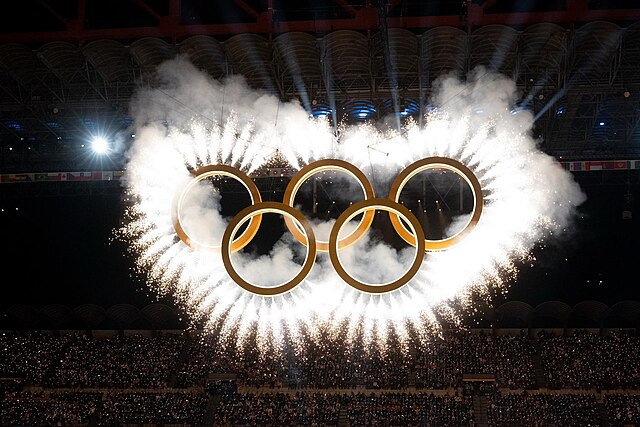
Every four years since 1924 there has been an international event watched by millions around the world. This year the 2026 Olympics are being held in Milano Cortina, Italy, a country that last hosted in 2006 and had various difficulties doing so. From high construction costs to abandoned infrastructure and even budget shortages, Italy didn’t make themselves a valuable image during those Olympics, but they tried again with new and innovative building strategies as well as the reuse of existing infrastructure.
TORCH RELAY
The Olympic torch relay first started in the 1936 Berlin summer Olympics. It was organized by Carl Diem; this inaugural relay saw 3,331 runners transporting the flame from Olympia, Greece, through seven countries (Greece, Bulgaria, Yugoslavia, Hungary, Austria, Czechoslovakia and Germany) to Berlin over 12 days. As per tradition, the torch was lit in Olympia, Greece on Nov. 26 to then move through the different Greek cities including Naousa, Kastoria, Metsovo, Athens and many more until Dec. 4. It was brought to Rome, Italy where the ceremonial relay started. The relay featured approximately 10,000 torchbearers during its 63 day journey passing through 60 cities in Italy. Some important Italian athletes were torchbearers including Sofia Goggia, an olympic downhill skier, Arianna Fontana, an olympic short track speed skater and many more. The torch was finally brought to Milan where it was placed in a cauldron beneath the Arco della Pace.
OPENING CEREMONY
The Opening Ceremony of the Milano Cortina 2026 Olympic Winter Games took place on Friday, Feb. 6, 2026, officially marking the start of the XXV Olympic Winter Games in Italy. The theme was “Armonia,” an attempt to bring countries together as the Olympics has traditionally done. There were some amazing performances with Mariah Carey, an American pop star that sang “Nel blu, dipinto di blu” by Domenico Modugno, Andrea Bocelli, an iconic Italian tenor and Laura Pausini, an Italian singer who sang the Italian national anthem. Other artists included the Italian rapper Ghali, actress Sabrina Impacciatore and dancers Antonella Albano and Claudio Coviello. After the various performances, athletes from all countries marched into the stadium with their flag leading each team.
SUSTAINABILITY
According to the International Olympic Committee (IOC), the 2026 Milano Cortina Winter Olympics were the first games to be guided from start to finish by the Olympic agenda reforms. These reforms are designed to make future games more sustainable, cost effective and transparent. Several key sustainability measures were put into place for these Olympics. The first was limiting new construction as much as possible, which is why almost 85 percent of all competitive venues already existed before the games. Additionally, a low-carbon Olympic village will be turned into student housing accommodating around 1,700 students after the Olympic games. The committee also limited snowmaking, using advanced technology and high altitude venue selection to help achieve this. Recovery, reuse and recycling of food across all venues contributed to sustainability throughout the entire Olympics. This was not an easy thing to accomplish, but the committee put their efforts and resources into it and were able to accomplish this for a better outcome in future games.
BALANCE WITHIN STADIUMS
The 2026 Milano Cortina Winter Olympics heavily features existing venues, with approximately 85 percent of infrastructure already in place. Some of the new buildings that were added and were used by athletes in Italy include the Milano Santa Giulia Ice Hockey Arena, seating approximately 15,000 spectators, and the Cortina Sliding Centre, seating around 3,200 spectators. The new stadiums and infrastructures were primarily funded by a mix of Italian public funds (national, regional and municipal governments) and private investments with significant contributions from the International Olympic Committee. The total amount for these different buildings and infrastructures amounted to about 1.8 billion dollars.
MEDALS
This year’s medals were made using recycled metal and eco-friendly, renewable-energy furnaces. They feature a sustainable, minimalist design representing “essence” and “unity” with a split circle, split texture design. They were produced by Italy’s state mint, the Istituto Poligrafico e Zecca dello Stato.
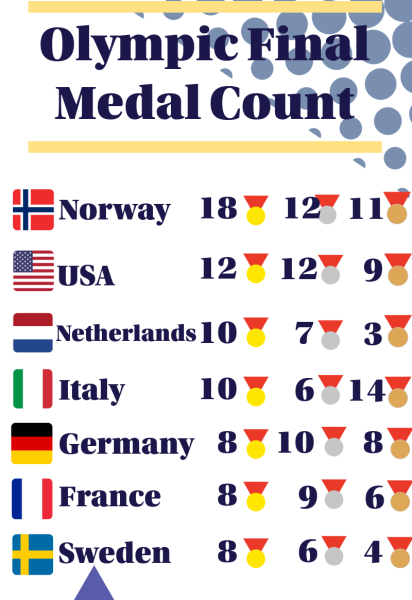
The final medal count showed shocking results. In first place with a total of 18 gold medals, 12 silver medals and 11 bronze medals was Norway, an unbeaten team since the 2014 Winter Olympics in Russia. In second place with a total of 12 gold medals, 12 silver medals and nine bronze medals was the United States of America, where both the men and women’s ice hockey teams won. In third place with a total of 10 gold medals, seven silver medals and three bronze medals was the Netherlands, known for their historical wins in long track speed skating with over 100 total medals. In fourth place with a total of 10 gold medals, six silver medals and 14 bronze medals was Italy, known for their historical dominance in alpine skiing, cross-country skiing and luge. In fifth place with a total of eight gold medals, 10 silver medals and eight bronze medals was Germany, known for their 50+ medals in the biathlon.
CLOSING CEREMONY
On Feb. 22, in Verona, famous for its romantic setting of Shakespeare’s “Romeo and Juliet,” the closing ceremony was held. The ceremony started with a DJ performance, followed by the Italian artist Achille Lauro. As per tradition, the next host of the Winter Olympics, the French Alps, was presented with the Olympic flag by the majors of Milano and Cortina d’Ampezzo. Following this, the volunteers of the event were recognized on stage, and almost 18,000 volunteers contributed to this year’s Olympics. Like in the opening ceremony, the athletes got a chance to walk representing their country in the parade of athletes. The ceremony closed out with a performance by the Italian opera members. After the closing ceremony, the central question for spectators was if Italy made themselves valuable as hosts in contrast to the 2006 Torino Winter Olympics. Many say that they improved in comparison with a new sustainability plan and reusing stadiums and infrastructure. Others think that the games could have a different outcome, having different artists or having their country win in different events.