
The astronauts left on the Orion spacecraft on April 1, from Launch Complex 39B at NASA’s Kennedy Space Center in Merritt Island, Florida. They returned on April 10, landing safely in the Pacific Ocean near San Diego, California. According to NASA, “The mission will pave the way for lunar surface missions, establishing long-term lunar science and exploration capabilities, and inspire the next generation of explorers.”
Artemis is one of NASA’s most pioneering projects: “Under Artemis, NASA will send astronauts on increasingly difficult missions to explore more of the Moon for scientific discovery, economic benefits and to build on our foundation for the first crewed missions to Mars.”
The Crew
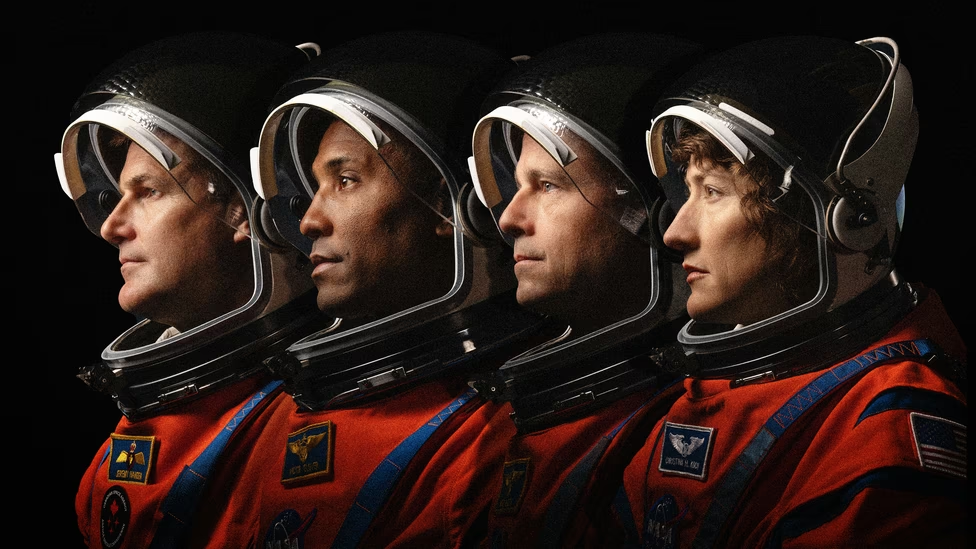
Four astronauts were a part of this mission around the far side of the moon, where they created a figure eight that extended more than 230,000 miles from Earth. Reid Wiseman was the commander, Victor Glover was the pilot and Christina Koch was one of the mission specialists. Jeremy Henson was the other mission specialist, coming from the Canadian Space Agency and being the first Canadian to go to the moon.
Social Media Sensation
Across multiple platforms, the entire mission has become a viral sensation. From edits of the crew members to hype videos of the mission itself, the internet has become infatuated with this moment of history.
While on the mission, the crew named one of the crater’s on the far side of the moon that NASA couldn’t identify. The crater was named Carroll after commander Wiseman’s late wife. Another crater was also identified and named Integrity.
Rise, the Zero Gravity Indicator
Along with the four astronauts, Rise, the zero gravity indicator and plushie mascot, was also on board to signal when the crew reached weightlessness. The plushie was designed by eight year-old Lucas Ye from Mountain View, California. Rise carried the names of over 5.6 million people who signed up for NASA’s “Send Your Name with Artemis” campaign on a micro SD card.
The name “Rise” and design comes from the iconic “Earthrise” photograph captured by astronaut Bill Anders during the Apollo 8 mission in December 1968, which was the first crewed journey around the moon. Ye included many details to highlight past space exploration. On the back of Rise, a space suit footprint recalls Neil Armstrong’s Apollo 11 moon landing in 1969. The Earth baseball cap that Rise wears has past and future space missions, that being Apollo and Space Launch System. The brim of the cap highlights the Orion constellation, which is the name of the spacecraft the astronauts used for this mission.
Future Forward
As innovation keeps enhancing and elevating human capabilities, space travel will continue to surpass past accomplishments. Artemis II is only one of the five missions planned out by NASA. The first mission, Artemis I, was launched in 2022. Artemis III, IV and V are planned for 2027, early 2028 and late 2028. With these future endeavors, NASA hopes to eventually have the first Artemis lunar landing.
On April 5th, pilot Glover delivered an unprepared speech that inspired many.
“You guys are talking to us because we’re in a spaceship really far from Earth, but you’re on a spaceship called Earth that was created to give us a place to live in the universe, in the cosmos,” Glover said. “You have this oasis, this beautiful place that we get to exist together… This is an opportunity for us to remember where we are, who we are, and that we are the same thing and that we got to get through this together.”